History and archaeology / Mound (höyük)
Çatalhöyük Neolithic Town
Çumra, Konya
A Neolithic town where thousands of people lived between 7400 and 6000 BC; a UNESCO World Heritage Site with its wall paintings and houses entered from the roof.
Safety warning
Its story
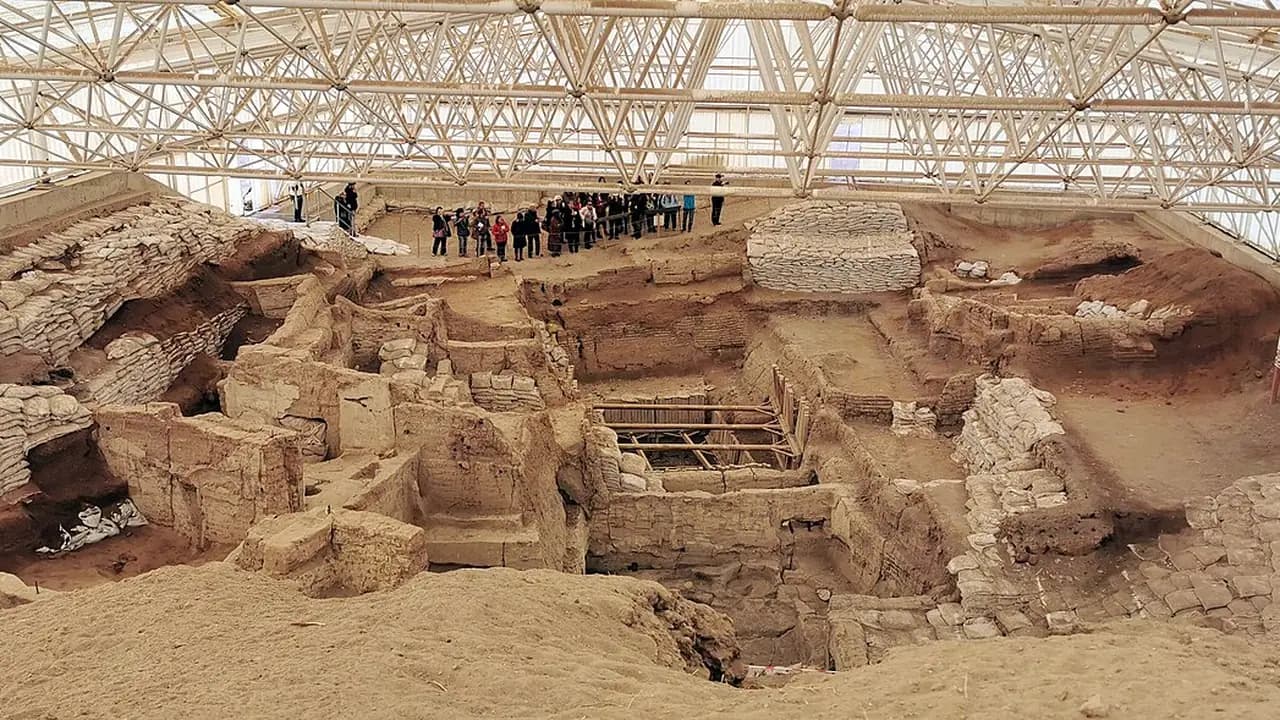
Çatalhöyük consists of two mounds rising side by side on the Konya Plain: the eastern one contains the Neolithic settlement and the western one the Chalcolithic. On the eastern mound people lived continuously for about two thousand years; the adjoining mud-brick houses, with no streets between them, were entered from the roof by ladder. Wall paintings with hunting scenes and geometric patterns, platforms with bull horns and figurines of seated women came from here. The first excavations were carried out in the 1960s by James Mellaart and continued after 1993 with international teams. At the site, added to the UNESCO World Heritage List in 2012, the excavation areas under protective roofs and experimental house reconstructions can be visited.
Key facts
- Hours
- Daily 09:00–17:00 (the North shelter may be temporarily closed; current information on muze.gov.tr)
- Period
- 7400–6000 BC (Neolithic), western mound Chalcolithic
- UNESCO
- 2012
- Visit duration
- 1–1.5 hours
Trip purpose
- Photography
- Day trip
- Traveling with kids
Location
37.66679, 32.82526
Where to eat nearby
No food & drink venues listed nearby.
Map data: © OpenStreetMap contributors; Overture Maps
Reviews
No approved reviews yet. Reviews are written in the app after a visit.
Source: Web derlemesi (doğrulanmalı): https://tr.wikipedia.org/wiki/%C3%87atalh%C3%B6y%C3%BCk | https://en.wikipedia.org/wiki/%C3%87atalh%C3%B6y%C3%BCk | https://muze.gov.tr/muze-detay?sectionId=KCO01&distId=MRK | https://whc.unesco.org/en/list/1405/ | https://www.wikidata.org/wiki/Q192522