History and archaeology
25 places
Your location is only used in your browser to sort nearby places; it is never stored.
25 places listed
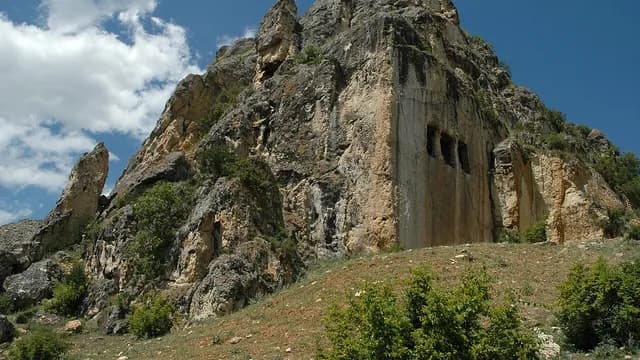
Rock tomb
Aslantaş and Yılantaş Rock Tombs
İhsaniye, Afyonkarahisar
Phrygian rock tombs comprising Aslantaş, with giant lion reliefs on its façade, and the toppled Yılantaş.
Ayazini Rock Settlement
A historic village in the Afyon section of the Phrygian Valley, full of rock-carved houses, churches and burial chambers.
Kaunos Rock Tombs
Köyceğiz, Muğla
Tombs with temple facades carved into the rock on the banks of the Dalyan River.
Tomb of Amyntas (Amintas Kaya Mezarı)
Fethiye, Muğla
A 4th-century BC Lycian tomb carved into the cliff above Fethiye, imitating an Ionic temple facade.
Amasya King Rock Tombs
Merkez, Amasya
Monumental rock tombs of the Pontic kings carved into the slope of Mount Harşena; the symbol of Amasya and on the UNESCO World Heritage Tentative List.
Aynalı Mağara Rock Tomb
A Hellenistic rock tomb with a polished facade, carved into the rock northeast of the city center; traces of Byzantine-era wall paintings survive inside.
İskilip Castle and Rock Tombs
İskilip, Çorum
A castle on top of a natural rock mass about 100 meters high in central İskilip, and Roman-period rock tombs with lion and Eros reliefs on its southern foot.
Kapılıkaya Rock Tomb
Laçin, Çorum
A 2nd-century BC Hellenistic rock tomb carved into a steep rock mass between Laçin and Kırkdilim, with the inscription 'Ikezios' on its door.
Kalekapı Rock Tomb
Taşköprü, Kastamonu
A monumental Paphlagonian rock tomb carved into a steep rock mass near the village of Donalar in Taşköprü.
Tikenlice Rock Tombs
Gürgentepe, Ordu
A group of monumental tombs carved into the rock in the Tikenlice neighborhood of Gürgentepe.
Tozkoparan Rock Tomb
Ünye, Ordu
A rock tomb about 5 km east of Ünye, with a large round-arched entrance and two nested chambers.
Salar Rock Tomb
Boyabat, Sinop
A monumental rock tomb carved into the rock in the village of Salar in Boyabat, dated to the Paphlagonian period, and the ecotourism route around it.
Beşdut Rock Tombs
Merkez, Çankırı
Two monumental rock tombs, one with columns, carved into the rocks on either side of the stream in Beşdut village.
İndağı Rock Tombs
Ilgaz, Çankırı
Caves, rock tombs and the remains of a rock temple carved into rocky slopes overlooking the Devrez Stream southeast of Ilgaz.
Sakaeli Rock Tombs and Gelin Kayası
Orta, Çankırı
Roman–Byzantine rock tombs carved into a hillside in Sakaeli village, Orta, and the fairy chimneys at the Gelin Kayası area.
Gerdekkaya Rock Tomb
Seyitgazi, Eskişehir
A Hellenistic-period monumental tomb carved into the rock near the village of Çukurca, with a facade with a pediment and two columns.
Köristan Archaeological Site and Rock Tombs
Sarıveliler, Karaman
Roman-period rock tombs within a cedar and fir forest near Göktepe, with pediments carved with Medusa and lion reliefs.
Köskerlik Rock Tombs (Sidamara Necropolis)
Ayrancı, Karaman
Rock tombs going back to the Hellenistic–Byzantine periods near the village of Ambar, where the famous Sidamara sarcophagus was found.
Myra Ancient City
Demre, Antalya
An ancient city famous for its house-type Lycian tombs carved into sheer cliffs overlooking the Demre plain and its Roman theater.
Teimiussa and Üçağız
A small Lycian harbor settlement on the shore right beside Üçağız village, with sarcophagi and rock tombs.
Beşikli Cave
Samandağ, Hatay
A Roman-period necropolis beside the Titus Tunnel, with many burial chambers carved into the rock.
Haydaran Rock Tombs
Merkez, Adıyaman
A Commagene-period site near Taşgedik with rock tombs and a relief of the Sun God Helios shaking hands with King Antiochus.
Turuş Rock Tombs
Roman-era rock tombs just west of the Adıyaman–Şanlıurfa road, reached by 10–13 steps, some with reliefs on their doorways.
Hilar Caves (Rock Tombs)
Ergani, Diyarbakır
Rock-cut caves just south of Çayönü, used as tombs between AD 100 and 325; registered as an archaeological site in 2024.
Kızılkoyun Necropolis
Eyyübiye, Şanlıurfa
An ancient cemetery of numerous rock tombs from the Roman and Byzantine periods on the rocky slope between Balıklıgöl and the museum.